A catalogue of harms people want to overcome, the better conditions they want instead, and what new capability might make possible.
How to use this
Start with the aspiration.
This is not a definitive list, and it does not say that everyone shares one ideal life. Each concern should begin with people affected by it: what they want changed, what they want protected, and what improvement would mean in practice.
Then we can ask what keeps that improvement out of reach, whether superintelligence (SI), robotics or abundant energy could change those conditions, who should decide, and what safeguards or evidence are missing. A capability is an opportunity; it is not permission to impose an answer.
Illustration and scene
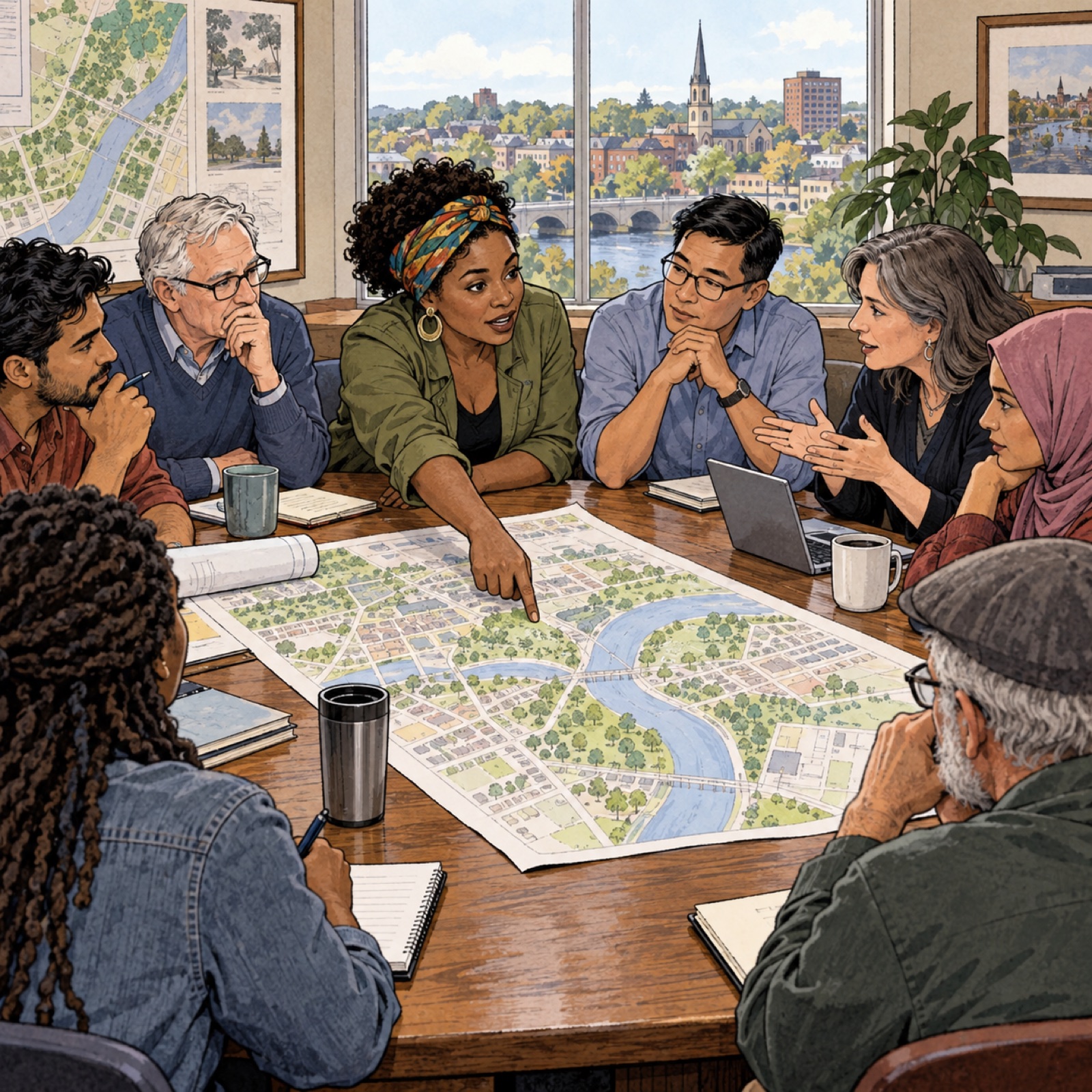
The wider ideaAI-generated editorial cartoonEveryday lifeAI-generated illustrative scene, not documentary photography
Illustrative entries
01
Climate damage and pollution
Life sought: comfortable homes and mobility, clean air and water, a stable climate and flourishing ecosystems.
Possible contribution: design and coordinate low-emission power, efficient buildings and transport, maintenance, materials recovery and pollution prevention.
Still to resolve: mining, land use, construction impacts, infrastructure ownership and fair access.
02
Animal killing for food
Life sought: nourishing, enjoyable food without avoidable animal suffering.
Possible contribution: improve plant-based foods, precision fermentation and other alternatives while making food production reliable and less wasteful.
Still to resolve: nutrition, affordability, culture, ecology, livelihoods and whether alternatives genuinely meet people's needs.
03
Competition for necessities
Life sought: secure access to food, housing, healthcare, education, mobility and meaningful choice.
Possible contribution: reduce production bottlenecks, coordinate services and maintain infrastructure before it fails.
Still to resolve: abundance does not distribute itself; ownership, eligibility, public authority and local choice remain political.
04
Domestic violence and coercive dependence
Life sought: safety, privacy, trusted support, stable housing and the practical ability to leave.
Possible contribution: connect confidential support, accommodation, transport and health or legal services sooner.
Still to resolve: surveillance can endanger people; survivor control, human support and privacy are essential.
Life sought: a safe, stable place to live, with privacy and room to recover or make plans.
Possible contribution: faster construction, maintenance, matching and access to support, with safer transitions between emergency and permanent housing.
Still to resolve: land, community consent, continuity of care and who controls access.
From a catalogue of misery to one of possible improvement.
Each entry is provisional. Keep current evidence separate from proposals and hopes. Do not treat affected people as problems to be optimised. Ask what they want, and whether a proposed system gives them more room to act.
This catalogue is a starting framework, not an endorsed or exhaustive programme. Evidence and local participation are needed for each entry. For the environmental and food-system claims in the featured essay, see its source notes.