The supermarket after the end
My childhood attraction to the communist ideal meets the supermarket question: what breaks first when the supply chain fails?
Planned — not yet releasedA 12-part series · Martin Davies-Roundhill
What happens to everyday life when the systems behind the supermarket stop working?
A 12-part inquiry by Martin Davies-Roundhill into food, choice, work and power after a civilisational breakdown. The starting point is a very ordinary question: if the shelves are no longer stocked by competing firms, who decides what gets made and who gets it?
Read this series in: English · Español · Português (Brasil) · Français
Explore the twelve parts ↓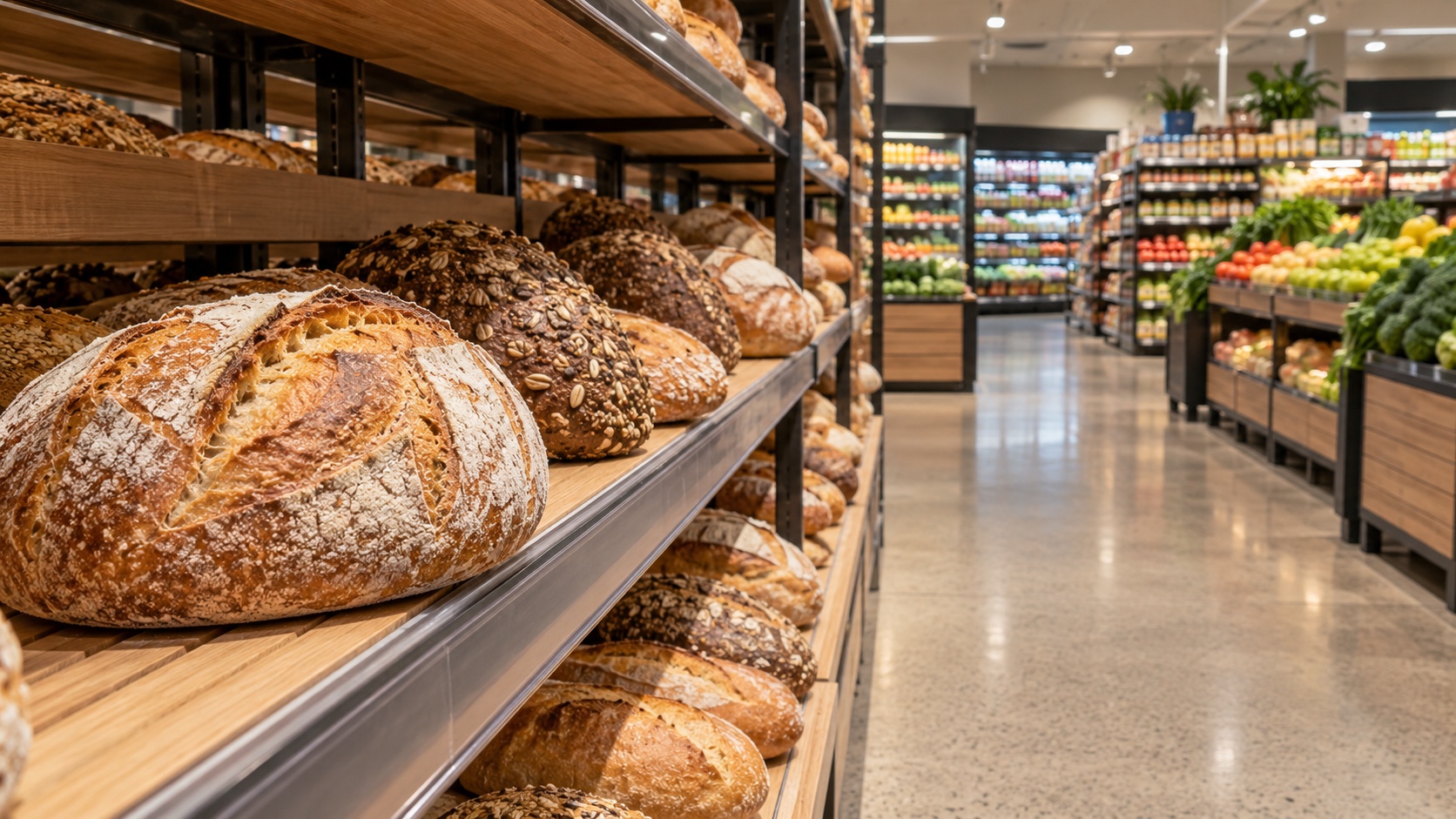
This began with my thought that a post-apocalyptic society might look more communist than capitalist—not because people had read Marx, but because survival could make shared provisioning unavoidable. I remember being drawn to the communist ideal when I was young. Later, reading about kibbutzim and the practical strains of communal life made the question more complicated. I want to test the thought, not announce a prediction.
Kibbutz background: Abramitzky’s review.
The central question
My opening hunch is conditional: a long breakdown could bring common stores, rationing, shared production or allocation by need. But crisis does not automatically create communism. It may also produce barter, private hoards, black markets, patronage, armed control—or a mixed order. The deciding questions are who owns productive assets, who allocates essentials, who can challenge those decisions, and what kinds of exchange remain.
Communism can mean a theoretical classless society organised around common ownership; a movement pursuing that ideal; or, in everyday speech, states governed by communist parties. Socialism covers a wide family of projects and is not simply a synonym. Lenin described a lower phase of communist society, often called socialism, and a higher phase; that is an influential Marxist account, not a universally accepted dictionary rule. Totalitarianism describes a form of political domination, not an economic system by itself. These distinctions matter because a shared food depot is not the Soviet Union.
The supermarket thought experiment is about institutions as much as labels. If national brands vanish, product variety need not vanish: recipes, local makers, quality marks and personal reputations could return. Nor does a shelf full of goods prove free choice if transport, energy, refrigeration, seed and processing have failed. Follow the chain behind the shelf—and ask who controls each link.
Food-system context: OECD resilience review · USDA regional produce markets.
The series compares market prices, public planning, rationing, commons, mutual aid, barter and coercive command. It asks what each can do under abundance, scarcity and unequal power. A system can combine them: a community may share staple food while people trade tools or reserve private space. The practical contrast is not simply capitalism versus communism; it is also accountable cooperation versus concentrated control.
The series
My childhood attraction to the communist ideal meets the supermarket question: what breaks first when the supply chain fails?
Planned — not yet releasedSeparate Marx’s theoretical horizon, socialist transitions, party-states, anarchism and everyday uses of the word.
Planned — not yet releasedCompare need, queues, ration cards, prices, lotteries, care and favour—and ask who can appeal.
Planned — not yet releasedA brand is more than a logo: quality signals, consumer choice and producer reputation can reappear locally.
Planned — not yet releasedMarx’s famous needs formula belongs to a specific account of a higher phase, not a simple recipe for a crisis shop.
Planned — not yet releasedWhat communal ownership and consumption can teach us—and what later reforms reveal about incentives and changing preferences.
Planned — not yet releasedWhy public ownership is not the same as democratic control, and why state socialism is not Marx’s completed ideal.
Planned — not yet releasedBarter, informal exchange, money, hoarding and black markets can emerge even where people share necessities.
Planned — not yet releasedFree riding, care work, status, expertise, dissent and exit: the frictions that good intentions do not dissolve.
Planned — not yet releasedMutual aid, local democracy, military command, patronage and mixed economies point to different possible futures.
Planned — not yet releasedTest ownership, allocation, accountability and the boundary between common infrastructure and private life.
Planned — not yet releasedA conditional answer: some post-collapse arrangements could be communist in meaningful respects, but the label must be earned by the institutions.
Planned — not yet releasedThe broad subject is not new. Post-collapse fiction, disaster sociology, utopian writing and political theory have explored cooperation, communes and authoritarian control. Ursula K. Le Guin’s The Dispossessed is an explicit, influential exploration of an anarchist society; disaster studies document both solidarity and inequality. My contribution is the route into the subject: the disappearing supermarket brand as a way to ask how ownership, logistics, variety and distribution would be rebuilt. I make no claim to be the first.
Related work: kibbutz research · emergency-behaviour review · disaster-communitas study · post-apocalyptic scholarship · Le Guin.
Research and interpretation are attributed; future scenarios are thought experiments. Disaster research concerns particular emergencies and cannot by itself predict generations-long social order.
The series is Martin’s independent inquiry. For correspondence, use the End Up Here contact page. No thinker, community, kibbutz or organisation discussed here has endorsed it.