Wires and sockets
For homes, workshops and appliances with substantial power demands, a maintained electrical network remains direct and efficient. Public charging points and power outlets could make that familiar access more widely available.
End Up Here · energy and ordinary life
A practical question about an abundant future
In a post-agentic world, to power my microwave, do I just plug it into the nearest socket in the nearest tree?

The last metre matters
Electricity can be plentiful in the system and still be awkward to use in a particular room, street, park or remote place. A person doesn’t experience a power station or a grid-control room. They experience a socket, a charging pad, a battery, or the lack of one.
The future imagined here assumes that the wider energy infrastructure can operate and renew itself with very little human labour. That is a premise for the thought experiment, not a claim about today’s electricity systems. The next question is how that system meets people in different places.
“Everywhere” may mean a dependable layer of shared access points, plus portable power for the places that network has not reached yet.
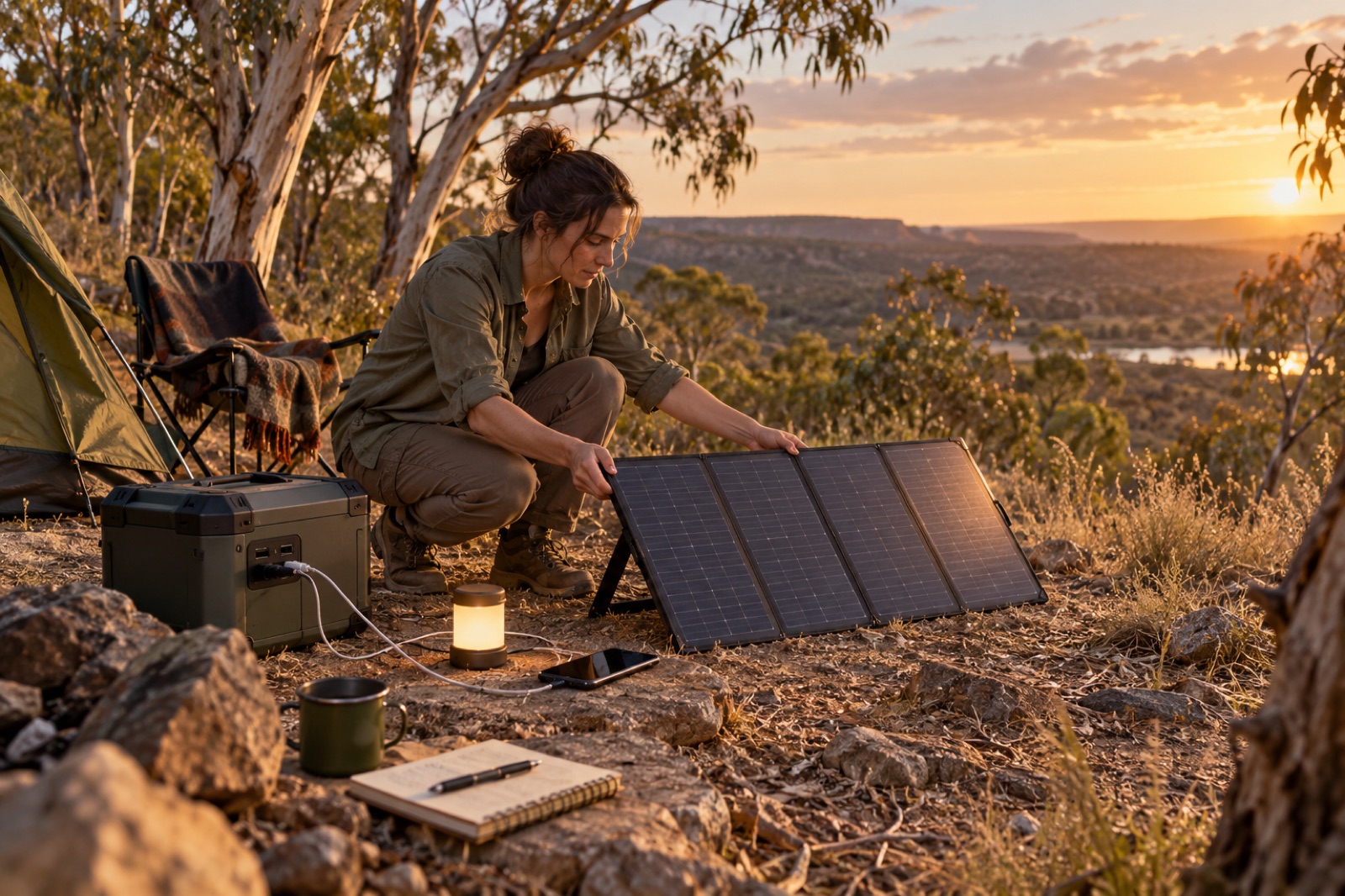
Four ways power could meet us
For homes, workshops and appliances with substantial power demands, a maintained electrical network remains direct and efficient. Public charging points and power outlets could make that familiar access more widely available.
Inductive charging already lets a device take power from a nearby pad or coil. Future furniture and work surfaces may hide the handoff. It still needs a nearby transmitter and compatible receiver; it is not a free-floating field that powers a microwave across a park.
Foldable panels, batteries and efficient devices let people bring electricity with them. Solar can charge a battery when the sun is available; stored energy carries that electricity into the evening or indoors.
Neighbourhoods can combine rooftops, shared batteries, local generation and grid connections. The person plugs into an ordinary outlet while the system balances which source is working at that moment.
Transportable fission microreactors are being developed for remote communities and industrial sites. They are the size of substantial equipment or a containerised plant, with regulated sites and supporting infrastructure—not personal power packs.
Radio or optical energy could send power without a cable in carefully designed settings. Space solar power is still a research and systems-engineering challenge. It is not a likely default replacement for street wiring in the near term.
Where the technologies stand · checked 8 October 2026
Solar photovoltaics, batteries, grids, off-grid solar kits and microgrids already give people different ways to access electricity. The International Energy Agency reports record solar growth in 2025, while also describing grid expansion and flexibility as continuing needs. Abundance therefore depends on connecting and balancing resources as well as building generation.
Microreactors are compact nuclear fission designs intended for remote and specialised users. In September 2026, a Westinghouse eVinci test reached criticality in a research facility. That was an experimental milestone—not an operating neighbourhood power station or a commercial deployment. The DOE’s DOME test bed is preparing to host fueled microreactor experiments.
Fusion aims to produce energy by combining light nuclei. A DOE roadmap published in 2026 targets a U.S. fusion pilot plant in the mid-2030s, while identifying difficult materials, fuel-cycle, plasma and plant-engineering gaps. The date is a programme goal, not a guaranteed forecast. A tiny fusion reactor that safely powers one appliance is an even more speculative step.
Even if a compact reactor eventually supplies a town, there is still a chain between the reaction and the socket: fuel handling, heat management, power conversion, shielding and safety systems, control, maintenance, regulation and a distribution network. Fusion would not make that engineering disappear. It could change the source feeding the network.
The person carrying the power
For a phone and a light, a small battery may be enough. For a laptop, a portable panel and larger battery could make a longer stay comfortable. For cooking, cooling or tools, people need much more power, and a shared connection becomes useful again.
Storage may improve and become lighter. That does not remove the basic difference between a low-power device and a microwave. A future “power kit” might be as ordinary as a bag, with a battery, a fold-out panel and adapters—but that is a design possibility, not a claim that a pocket-sized reactor is around the corner.
The more ambitious form of portability could be infrastructure that follows us: transport, public spaces and buildings offering standard, interoperable charging, backed by clean generation and storage across the local network.
The question to keep asking
When power is no longer scarce, where in your life would you want it to be effortless?
Three companion video outlines
These are research outlines for a possible three-part series. The technologies are evidence-led; the post-agentic world and its self-maintaining energy system remain the larger thought experiment.
VIDEO 01 · THE EVERYDAY QUESTIONWhere Do I Plug In? ↘ VIDEO 02 · PORTABLE POWERCould I Carry My Own Electricity? ↘ VIDEO 03 · LOCAL SOURCESWhat Might Power a Neighbourhood? ↘Open with the tree socket and microwave. Walk through a day from home to street to bush. Explain sockets, short-range charging, public access and local networks. Ask whether ubiquitous power feels like more outlets, more charging surfaces or something invisible and dependable. Close by distinguishing access from generation.
Start with a phone and lamp, then laptop, cooking and tools. Explain portable solar plus battery storage and why device demand changes the size of the system. Imagine lighter and more capable future storage without treating speculative density gains as guaranteed. Close on a useful shared-power kit, with wires still available for high-demand tasks.
Compare local solar and batteries, small modular fission, microreactors, geothermal where suitable, and possible future fusion. Use today / under test / imagined labels. Explain what the reactor must do beyond producing heat, and why a microreactor is infrastructure for a site or community rather than a personal appliance. Close with the prospect of people using power without needing to know which source is feeding the socket.
Sources and boundaries
This page is a future-facing thought experiment. It does not predict that energy will become free, that fusion will reach a particular date, or that small reactors will be placed in neighbourhoods. Company and government milestones are described as goals or tests, not proof of commercial readiness.
Technology-status check: 8 October 2026. Claims about this imagined future are Martin’s view; source links describe present programmes and evidence.