Every Radio Station You’ve Never Heard Of
2MW Murwillumbah: a voice for the Tweed
A small mark on an Australian radio dial opens a story about a local company, a young station and the people whose voices carried it.
Open the public video on YouTube · English narration. YouTube currently reports subtitles/closed captions unavailable in the public player. Studio shows an English subtitle timeline, but viewer availability remains unverified.
A licence, then a station
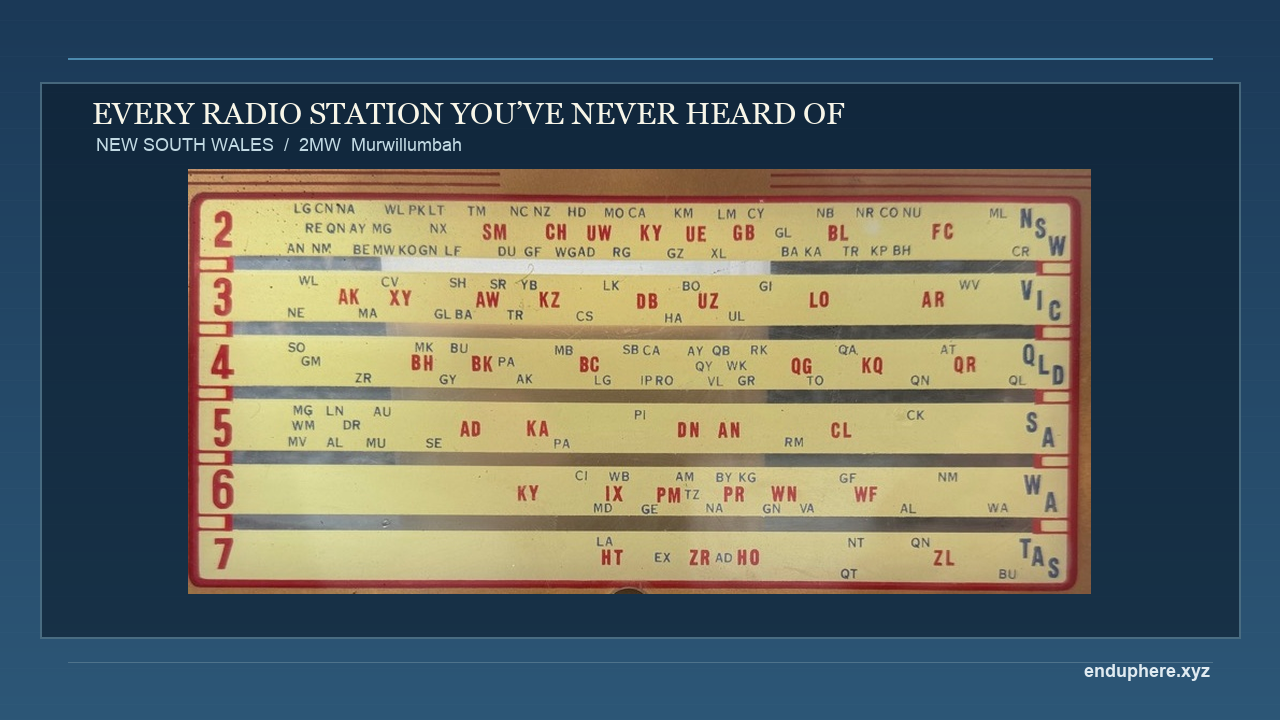
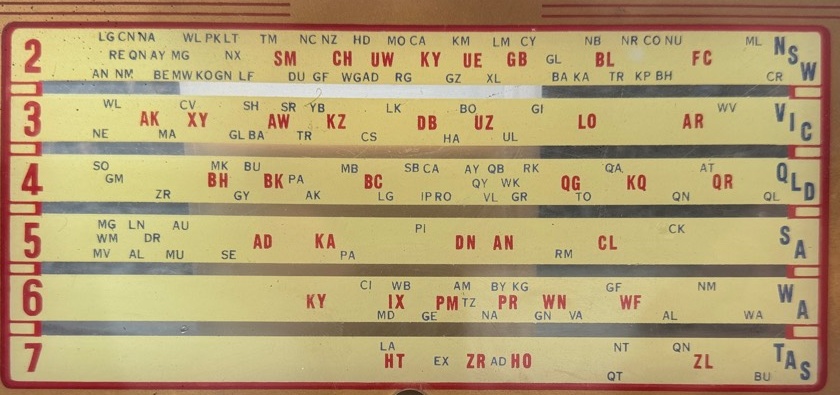
On the crowded Australian dial, the letters MW sit in the row marked 2. Dated station records identify the mark as 2MW at Murwillumbah, in the Tweed Valley of northern New South Wales. The photograph is a clue; it does not establish when the receiver was made.
The Postmaster-General’s Department issued Licence 127 in 1936, describing a proposed site north-east of Murwillumbah. The Tweed Regional Museum dates the station’s formal opening and first broadcast to the evening of 2 September 1937. A next-day report in the Tweed Daily says 2MW was officially opened the previous evening by E. S. Spooner. Those are separate milestones: the licence date is not the first-broadcast date.
A club and a printed number
A 1938 trade yearbook listed the 2MW Smile Club with a printed membership figure of 2,000. That is a contemporary directory entry, not an audited count. The museum separately recalls children singing and dancing during Saturday-morning broadcasts from the School of Arts; it does not date those broadcasts or confirm they were the same club entry.
Two dated technical snapshots
A 1939 yearbook gives one snapshot: 100 watts and 1,470 kilocycles, with the studio and transmitter on Condong Road. A 1965 directory lists 2,000 watts and 1,440 kilocycles, with the transmitter at Tumbulgum. These dated listings do not show a measured signal footprint.
The station advertised itself as “The 2-State Station.” A separate Australian Broadcasting Control Board report for 1965–66 says the Gold Coast received commercial service from 2MW, but that the service was technically inadequate for an area with a large, concentrated population. That is the regulator’s dated assessment, not a measured coverage map; it gives the slogan a useful counterpoint. The episode also follows a yearbook profile’s named announcers and programmes and a later local account of 2MW being off air during the 1954 flood.
Reading the dial and map
Sources
- Tweed Regional Museum, “Radio — the 2MW story” — licence, company and shareholding context, opening chronology, and the undated School of Arts recollection.
- Tweed Daily, “Murwillumbah Now on the Air,” vol. XXIV, no. 210, 3 September 1937, pp. 4 and 7, National Library of Australia/Trove — the visually inspected next-day report says 2MW was officially opened the previous evening by E. S. Spooner; it describes the opening dinner, Condong Road station and the company’s local ownership. The separate 2 September opening-night programme remains unchecked.
- Broadcasting Business Year Book 1938, digitised annual, printed p. 188 — the Smile Club listing.
- Broadcasting Business Year Book 1939, digitised annual — 1939 technical directory snapshot.
- Radex, vol. 113, November 1937, digitised issue, p. 95 — a contemporary report says 2MW had been heard testing on 1,470 kHz while construction was nearly complete. The original page image and transcription need checking; this is not the official opening date.
- Broadcast Year Book and Radio Listeners’ Annual 1946–47, Radio Heritage transcription — promotional station profile and staff/programme details.
- Tweed Shire / North Coast Area Health Service, “Murwillumbah Historic Walk: North Bank River Levee” — later local account of the 1954 flood and the station being off air.
- Australian Broadcasting Control Board, Eighteenth Annual Report, 1965–66, paras. 25–27 and Appendix A — the Board says the Gold Coast received 2MW service but judged it technically inadequate for the area’s concentrated population; Appendix A lists 2MW at Murwillumbah on 1,440 kc/s with 2,000 W on 30 June 1966. This indexed PDF text is cited as a dated regulator record; the page image has not been visually inspected.
- B&T Yearbook 1965, digitised annual — later frequency, power and transmitter-site snapshot, plus the station’s advertising slogan; page facsimile still needs inspection.
Research and editing: Martin Davies-Roundhill, for End Up Here. Narration uses the built-in macOS Daniel voice (British English). The linked English v1.1 video was approved by Martin. Visuals include the owner-supplied dial photograph, schematic locator maps and clearly labelled AI-generated historical interpretations; these are not archival photographs or portraits of named people.