End Up Here · Video essay · 5 October 2026
Which Skills Should We Keep Practising?
When capable systems can do more for us, which abilities do we still want to practise ourselves?
The video · 5:11
This is a narrated video essay based on an End Up Here topic-bank question; it is not a recorded podcast interview.
A useful distinction
Three reasons to keep a skill.
Recovery: a little direct ability can bridge the gap when a system fails. Judgement: doing a small part yourself can teach you what normal feels like and help you catch a poor answer. Meaning: some activities give a day shape because the doing itself matters.
These reasons are not a universal rule. The right amount of practice depends on the person, the risk and what they value. It should also remain easy to delegate without shame.
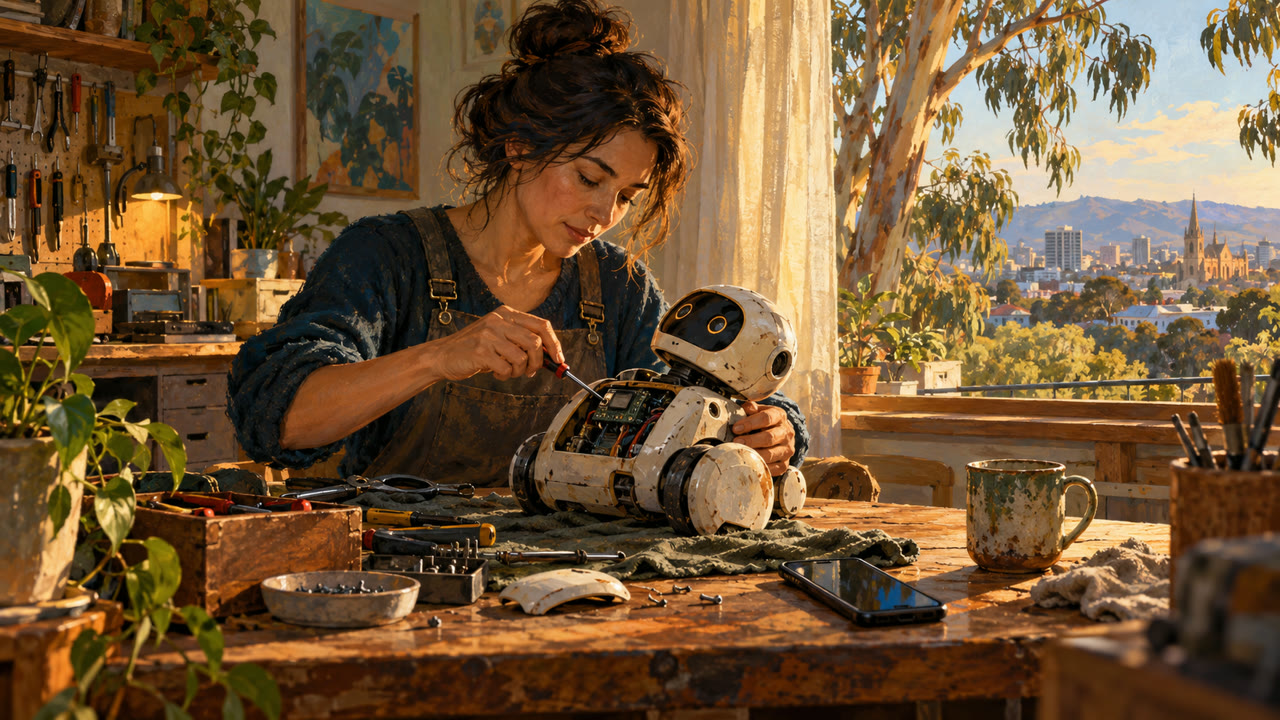
Recovery and choice

What the evidence supports
Specific findings, carefully bounded.
NASA aviation-safety reporting describes loss of manual flying proficiency as a concern when pilots have little opportunity to practise. A randomized study of 40 medical residents found better long-term test scores after repeated testing with feedback than after restudy. The first is a safety concern in one setting; the second is a study of retained medical teaching material. Neither proves a universal rule about every practical skill.
The three-part framework and design suggestion are End Up Here interpretations. Scenarios are not forecasts. The synthetic Moira narration and generated painted scenes are disclosed; the cockpit and medical-learning illustrations are not documentary source images.
Text alternative
Read the full narration transcript
This text follows the spoken narration; the headings match the video sections.
A shortcut can change what we know
Imagine a device that can repair almost anything in your home. You point its camera at a leaking tap, and it explains the fault, orders the right part, and guides a small robot through the repair. The water stops. The job is done.
Now imagine the system goes offline the next time something breaks. Would you know what to look for? Would you even know when its answer sounded wrong?
Automation is often measured by the work it removes. There is another question: what happens to the knowledge we no longer use?
The useful answer is not that people must keep doing everything by hand. It is that some abilities matter even when we rarely use them. They help us check a system, recover when it fails, teach someone else, or simply take pleasure in doing a thing ourselves.
Evidence from a narrow corner
We have real evidence that some kinds of performance can fade without practice, though the details depend on the skill and setting.
NASA human-factors researchers have treated loss of manual flying proficiency during heavy reliance on automated flight systems as a safety concern. One NASA report describes “flight skills degradation” as including erosion of manual handling and navigation skills when crews have little opportunity to practise them. This does not prove that automation inevitably makes every pilot less capable. It identifies a specific risk in a high-stakes environment and asks how crews can retain a fallback skill.
A separate randomized study followed 40 medical residents after a teaching session. Some practised by answering questions with feedback; others restudied the material. More than six months later, the testing group scored higher on the study topics. That is evidence about retained medical knowledge after a particular teaching intervention, not about repairing a motor or learning to cook. It does suggest that practice can be designed to keep knowledge available rather than merely present it once.
Those findings do not settle a universal rule. A memory test is not a manual skill. A cockpit is not a kitchen. The evidence tells us to ask which abilities are vulnerable, and what kind of practice maintains them.
Three reasons to keep a skill
I would keep practising a skill for at least three different reasons.
First, recovery. If a tool, network or service fails, a little direct ability can bridge the gap. You may not need to rebuild the whole system. You may need to recognise a hazard, shut something off, make a safe temporary fix, or explain the problem clearly to a person.
Second, judgement. Doing a small part yourself can teach you what normal feels like. A cook learns how dough changes. A cyclist learns what a loose brake feels like. A person who has used a map understands why a route suggestion is impossible. The skill becomes a way to inspect the machine’s output.
Third, meaning. Some activities are worth doing because the doing itself gives a day shape. Playing an instrument, growing food, making furniture or learning a language can be valuable even when a machine could produce a more polished result in seconds.
These reasons can overlap, but they are not the same. A skill kept for emergencies needs a different amount of practice from one kept for pleasure. A skill kept to audit an AI may need less mastery than a skill kept to earn a living from craft.
Let help teach, not replace
This suggests a practical design test. When an assistant performs a task, does it leave the person with less ability—or offer a route to build ability if they want it?
A system that repairs a bicycle could show the diagnosis, name the part, and let someone try the simple adjustment under safe conditions. It can do the repair for a person who prefers that. It can also offer a patient lesson, keep a checklist, and help the owner recognise when the problem requires a professional.
But learning options should not become another burden. People are tired, disabled, busy, or simply uninterested in mastering every household system. They should be able to delegate without being scolded for it. And some tasks are dangerous: a helpful tutorial must not make risky work seem safe for everyone.
The choice to learn should be real. So should the choice not to.
A future with useful human ability
If machines become better at execution, human skill may shift. We might practise less repetition and more diagnosis, taste, repair, care, improvisation and teaching. Some abilities will fade because people choose other things. Others will be protected deliberately, especially where a fallback matters or where practice is part of a worthwhile life.
That is an editorial proposal, not a forecast. The important question is not how many skills a person can list. It is whether they can still act in ways they value, notice when automation is failing, and choose when to hand a task over.
Maybe a good tool should be able to do the job, show its reasoning, and make it easier to learn the job when learning matters. Maybe the future is not a contest between human hands and machines. It is a question of what we want our hands, attention and judgement to remain capable of.
Which ability would you keep practising even if a machine could do it faster? And which task would you happily hand over for good?
An open question
Which ability would you keep practising even if a machine could do it faster? Which task would you happily hand over?
Explore more End Up Here video essays and topic-bank questions.