End Up Here · Video essay
Narrated essay
Which decisions should remain hard?
If an assistant could take a thousand small decisions off your hands, which would you gladly give away—and which should make it slow down?
Video release
Which Decisions Should Remain Hard?
Watch “Which Decisions Should Remain Hard?” on YouTube. The 5:49 video uses synthetic narration and illustrative AI-generated/editorial visuals. English (Australia) captions are available from the CC control in the public player.
The question
Some effort is a tax. Some effort helps us choose.
A personal agent might choose a familiar route, reorder groceries, sort messages and move an appointment as the day changes. Taking those routine chores away could return attention to the person.
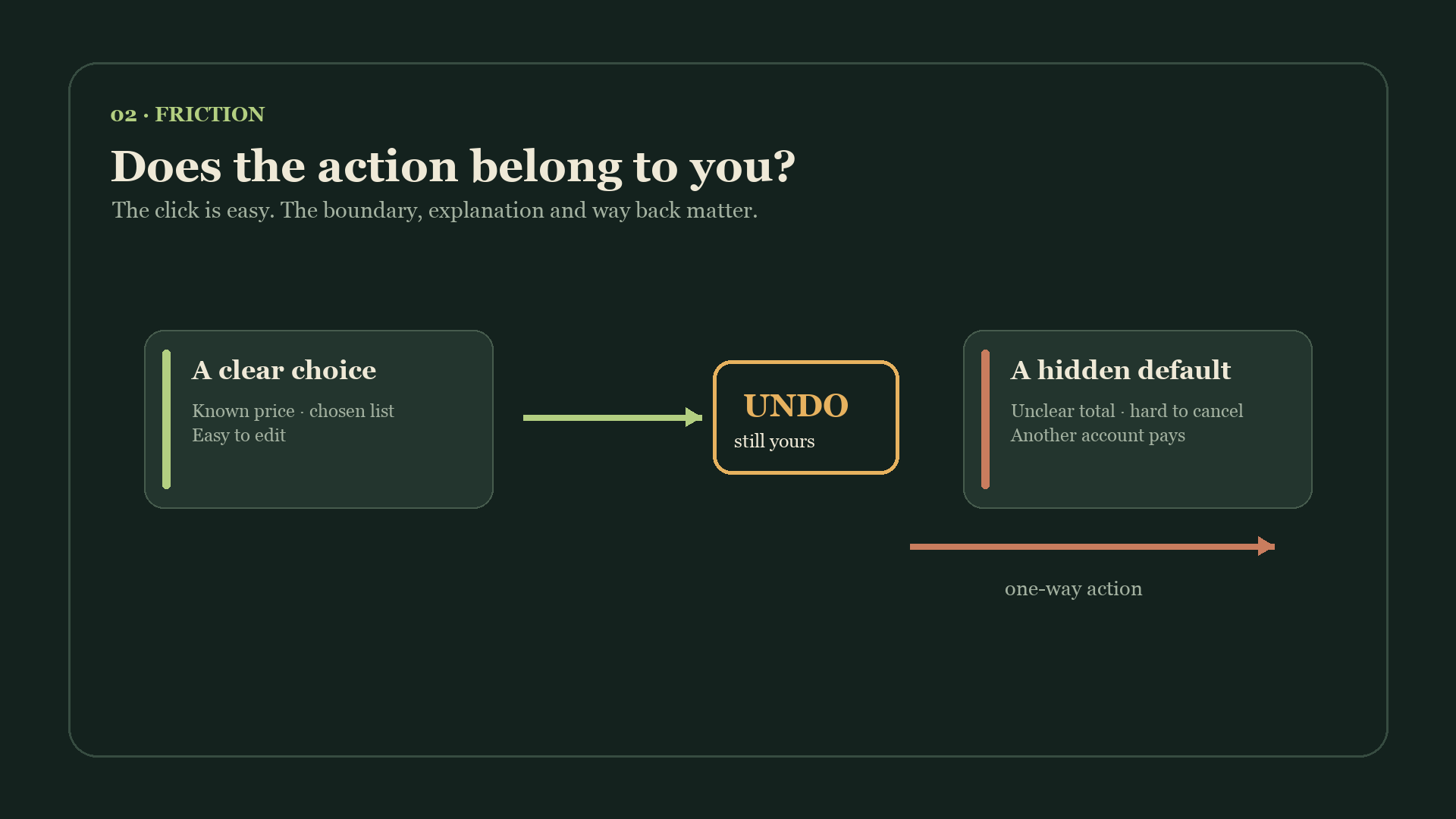
But friction can also create a moment to understand consequences, change a default or hear another view. A reversible everyday action does not need the same pause as sharing medical information, spending a large amount or sending a message that may alter a relationship.
The essay proposes three broad bands: let agents handle repetitive and reversible work within clear limits; make consequential routine actions legible and confirmable; and use AI to support reflection on personal or hard-to-reverse choices without quietly taking authority away from the person.
Evidence boundary: These decision bands and the “disagreement test” are editorial proposals, not a scientifically proven universal scale. The examples are hypothetical.
A person, and a way back

The complication
A system that never questions us can amplify a momentary impulse. One that constantly blocks us can become a quiet authority.
A useful assistant could offer a calmer draft, explain a trade-off or invite a short pause. If the person still chooses to continue, disagreement should not automatically become a locked door.
For serious choices, people need to see why the system paused, what alternatives it considered, what uncertainty remains, and how to act or ask for another view. Other people affected by a decision should not disappear from the picture.
Questions to carry forward
Which everyday decisions would you happily hand over?
When does a pause protect a choice?
What should an agent do when it disagrees with you?
Which decisions should stay open to another view?
Sources and status
The National Institute of Standards and Technology’s AI Risk Management Framework, Appendix C discusses defining human roles and responsibilities in AI decision-making and warns that measurement can remove context.
Saleema Amershi and colleagues’ human–AI interaction guidelines discuss making system capabilities and limits clear and giving people ways to correct or adapt systems. Neither source establishes one friction level for every decision.
The narration is synthetic. The opening scene is AI-generated and illustrative; the diagrams are original editorial visuals, not documentary footage. No real person or event is depicted.