The intelligent workshop
Electronics, restoration, fault-finding, measurement, open hardware, robots, salvage and the communities that teach these skills.
A field guide to tools, systems and possible lives after the agentic turn.
This is the first assembled form of the New Earth Catalog: its cover, editorial promise, table of contents and the pattern every future entry will follow.
The original Whole Earth Catalog helped people find tools for lives outside the standard pattern. This project carries that question forward into a world of intelligent machines, robotics, abundant energy, advanced medicine and more available time.
It does not prescribe one approved future. It builds a wide field of possible lives—practical, attractive and honest about what exists, what is emerging and what remains to be invented.
Edition status. Structure and direction are established. Most entries are intentionally open: this edition is the frame into which research, historical echoes, field reports and recommendations will be added.
The catalogue begins with the conditions of life, moves through capability and relationship, then opens into travel, inner life and futures that do not yet exist. Every major section will carry a small Then / Now / Next historical echo.
Place and shelter includes conventional homes, but it must also include people who live rough, move between places, or remain outside the housing system by preference, mistrust, habit or necessity.
Some people are homeless because they are unsafe, displaced, ill, exploited or excluded. Others could accept a government-provided suburban home yet choose street life, urban anonymity, mobility or independence from institutions. These realities can overlap; none should be simplified.
When material security becomes available, the question is not whether everyone can be made to settle. It is whether people can choose warmth, storage, sanitation, privacy, transport, companionship, land or a permanent home without losing the freedom to live otherwise.
What happens to homelessness and itinerant life when material security is available to everyone? Will some people choose a conventional home, while others continue living in streets, parks, vehicles, camps or temporary settlements?
People do not live in sections. They combine regions of the activity galaxy. These recurring strands connect the pages and keep the catalogue grounded in complete systems.
Electronics, restoration, fault-finding, measurement, open hardware, robots, salvage and the communities that teach these skills.
Homes, batteries, vehicles, ecosystems, knowledge, relationships and the social infrastructure that makes freedom durable.
Automated homes, makers, scholars, artists, carers, explorers, technologists, recluses and people who want a quiet life.
A catalogue entry is not an advertisement. It is a compact piece of orientation: what something does, who it is for, what it depends on, and what it might make possible.
The first populated spreads will use the Then / Now / Next rhythm: a small historical reference, the current capability, and the possible extension into a post-agentic life.
One clear sentence describing the capability or possible life.
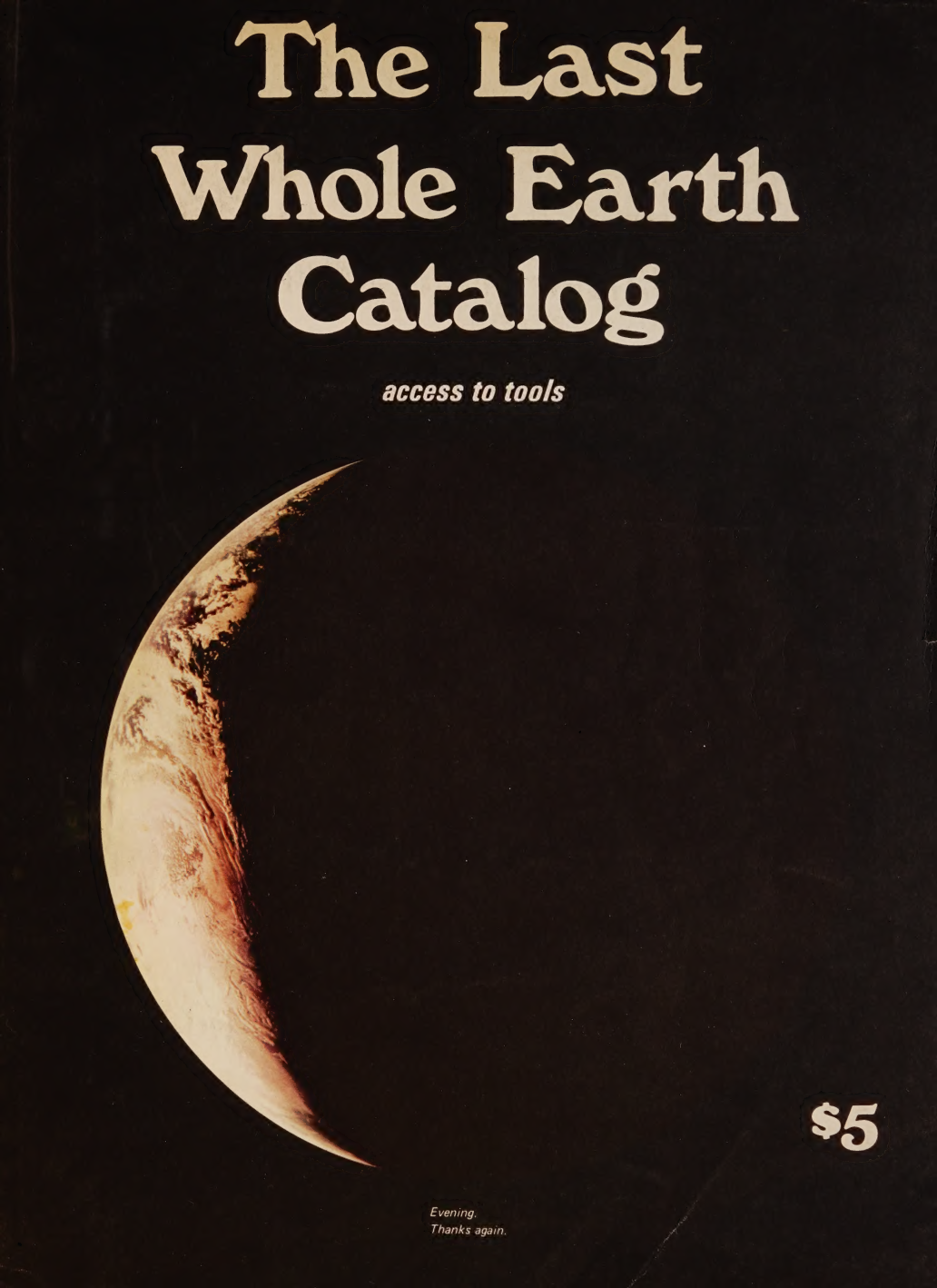

Each major section will place the new work beside a small, source-linked historical echo from the audited Whole Earth Catalog. The past gives us a measuring stick; it does not dictate the future.
THEN — What did people once reach for? What did it cost, and what capability did it represent?
NOW — What is available, and what has changed in cost, access, scale, safety or infrastructure?
NEXT — What becomes possible when intelligence, energy and automation are widely available? What still needs to be invented?
Rights-aware by design. Historical scans in working prototypes are reference material. Final publication will use factual citation, short attributed excerpts, public-domain or licensed material, permission, or newly made imagery.
“The catalogue is not a list of approved lifestyles. It is a wide field.”
The work ahead is to fill that field with enough evidence and practical detail that a reader can move from recognition to experiment.
The frame is in place. The next production pass is a small batch of fully researched entries and three designed Then / Now / Next spreads, followed by the source-linked sections that make the catalogue useful rather than merely beautiful.
View the three-spread prototype ↗