← enduphere.xyz All Guides
Martin Davies-Roundhill holding the original 1984 ChipWits disk
Personal Artifact  ·  Computing History  ·  1984

The Disk That Changed Everything

An original Version 1.0 ChipWits floppy — the first piece of Macintosh software I ever saw running, the first I ever bought, and the thing that made the promise of personal computing feel real. I have kept it for over forty years.

Before Bruce McLeod's house

By the early 1980s, I was already paying attention. The Apple I had happened. The Apple II had happened. Texas Instruments and a dozen other machines were stirring into public view. The personal computer revolution was beginning — not yet arrived, but you could feel the approach of it, the way weather comes before the rain.

I was not a developer. I was not inside the industry. But I was alert to it. Something was shifting in what a machine could be and what a person could do with one. I was watching that shift.

Then my friend Bruce McLeod bought a Macintosh.

Bruce was serious about technology — he did database work for the federal government, which in that era meant he was among the people who actually understood what computers were and what they were becoming. When he acquired a 128K Macintosh, he invited me over to see it.

What was running on it was ChipWits.

That was the moment. Not just "a new computer" — but a computer running software that immediately made its promise feel real. The graphics, the interface, the way the machine responded — everything about it was different from what had come before. ChipWits was not a demonstration program. It was an actual thing, a game with depth and wit and a logic that rewarded thought. And it was running on this small, extraordinary box that Bruce had bought.

The romance started there. In Bruce McLeod's house, watching a robot navigate a maze on a 9-inch screen, understanding for the first time what the Macintosh actually was.

I went and bought the disk. I still have it.

What this disk is

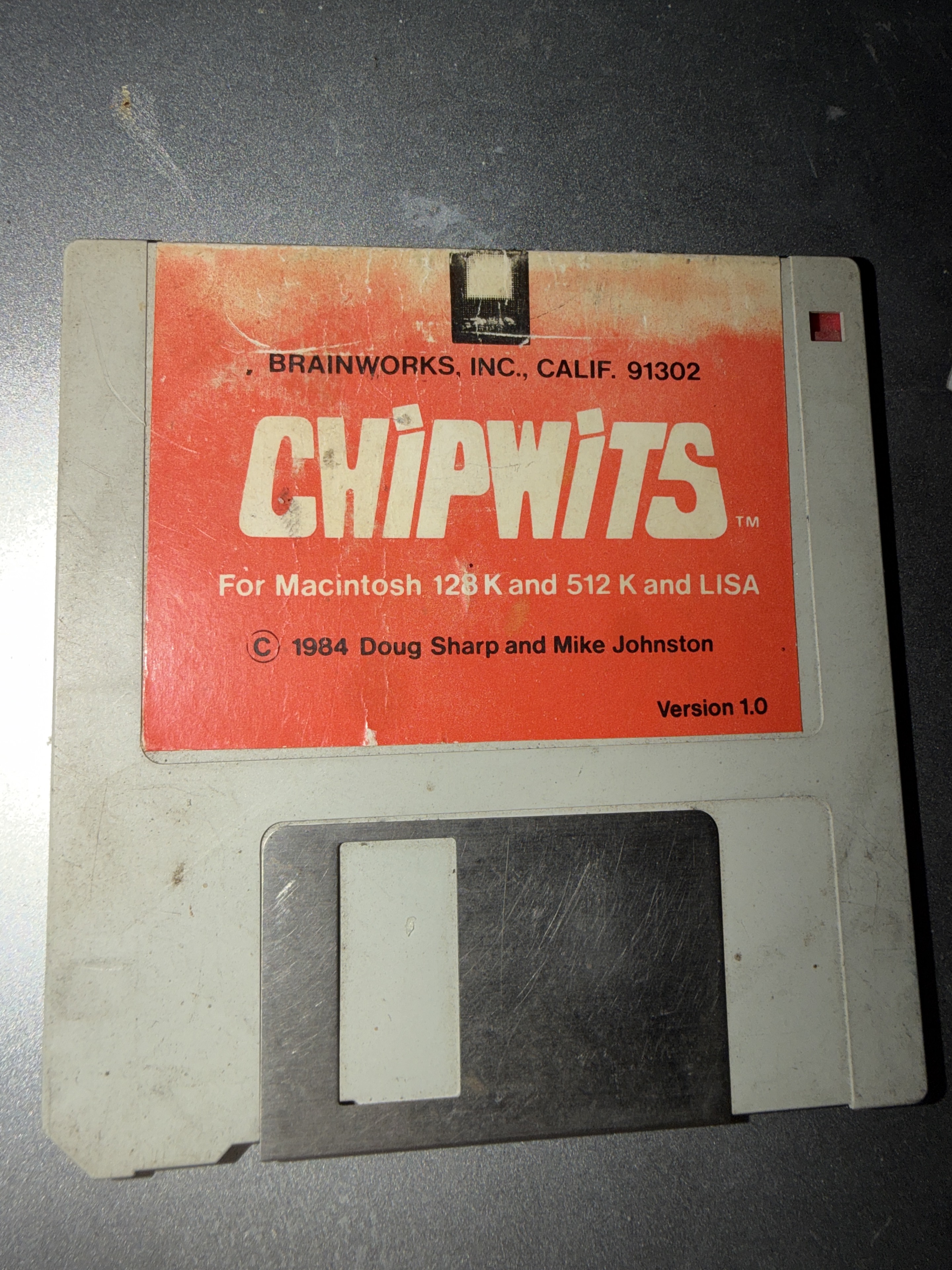
ChipWits disk label — Brainworks Inc, For Macintosh 128K and 512K and LISA, © 1984 Doug Sharp and Mike Johnston, Version 1.0
The label — Brainworks, Inc., Calif. 91302 · ChipWits™ · Version 1.0 · © 1984 Doug Sharp and Mike Johnston · For Macintosh 128K and 512K and LISA
Label — transcribed from photographs, verified
PublisherBrainworks, Inc., Calif. 91302
TitleChipWits™
PlatformFor Macintosh 128K and 512K and LISA
Copyright© 1984 Doug Sharp and Mike Johnston
Version1.0 — first release
Format3.5" Macintosh single-sided floppy (400K)
Martin holding ChipWits disk, label forward
Label clearly readable after four decades — Brainworks, 1984, Version 1.0
Martin with ChipWits disk, smiling
Still here. Still intact. The disk that started it.

What ChipWits was, and why it mattered

Released
November 1984
One of the first Mac titles — launch year
Creators
Doug Sharp & Mike Johnston
Brainworks / BrainPower, Inc.
What it was
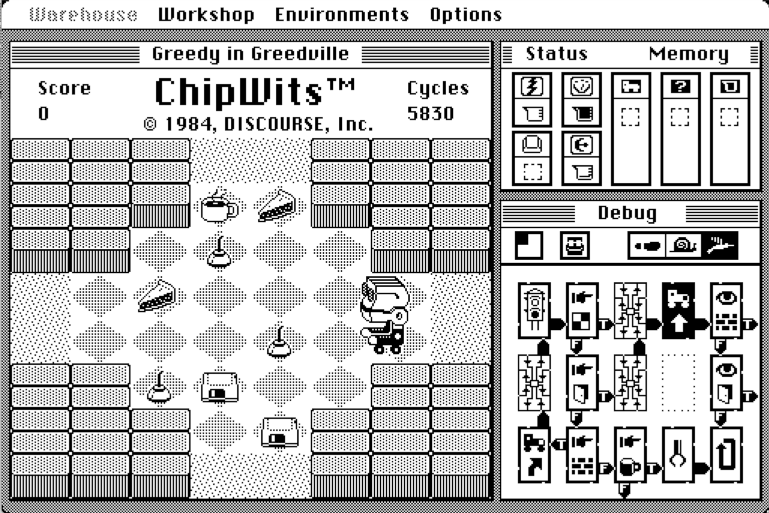
A visual programming game — teach a robot to navigate mazes using logic chips
Platforms
Mac 128K / 512K / LISA (1984)
Apple II & C64 via Epyx (1985)
Built with
MacFORTH — written directly on the Mac 128K, April to November 1984
Awards
MACazine Best of '85
MacUser Editor's Choice 1985
8th best Apple game — MacLife

The Macintosh launched in January 1984. ChipWits shipped for Christmas 1984 — within the machine's first year, when the total library of available Mac software numbered in the dozens. Doug Sharp and Mike Johnston developed it using MacFORTH, running directly on the consumer hardware, because they could not afford an Apple Lisa — the standard Mac development machine, which retailed at $9,995 (roughly $30,000 today).

The game itself was a programming puzzle. The player built logic programs — using a visual flowchart of "chips" — to direct a robot through increasingly complex mazes. You were not writing code. You were designing behaviour. The robot executed whatever you gave it exactly, and learning to think precisely enough to get it right was the point. Computer Gaming World called it an "incredibly vivid simulation experience." MacLife ranked it among the best Apple games ever made.

What made ChipWits significant was what it understood about the Macintosh. The early Mac had a graphical interface — menus, windows, a mouse — and most software of 1984 used that interface to replicate things that had existed before. ChipWits built something native to it: a visual logic system that would have been impossible to use on a text-based machine. It was not a port or a translation. It was a program that could only have existed on this hardware.

"ChipWits was one of the first games to be released on the 1984 Macintosh. Co-creators Doug Sharp and Mike Johnston worked part-time porting educational computer games between 8-bit microcomputers to earn enough money to pay rent."

— ChipWits, Inc. official history, 40th Anniversary, November 2024

In November 2024, on its 40th anniversary, ChipWits Inc. open-sourced the original MacFORTH code on GitHub. A modern reboot is in development and available on Steam. The original game is playable in emulation. The disk that started all of this — the 1984 Version 1.0 Macintosh release — is what Martin is holding.

Publisher name note

The disk label reads Brainworks, Inc. Wikipedia and other sources refer to the publisher as BrainPower. These may be the same entity under different trading names, or represent a label change between printings. The disk itself is the primary source. No definitive reconciliation was found.

What it is worth — an honest assessment

Market value — bare disk, original condition

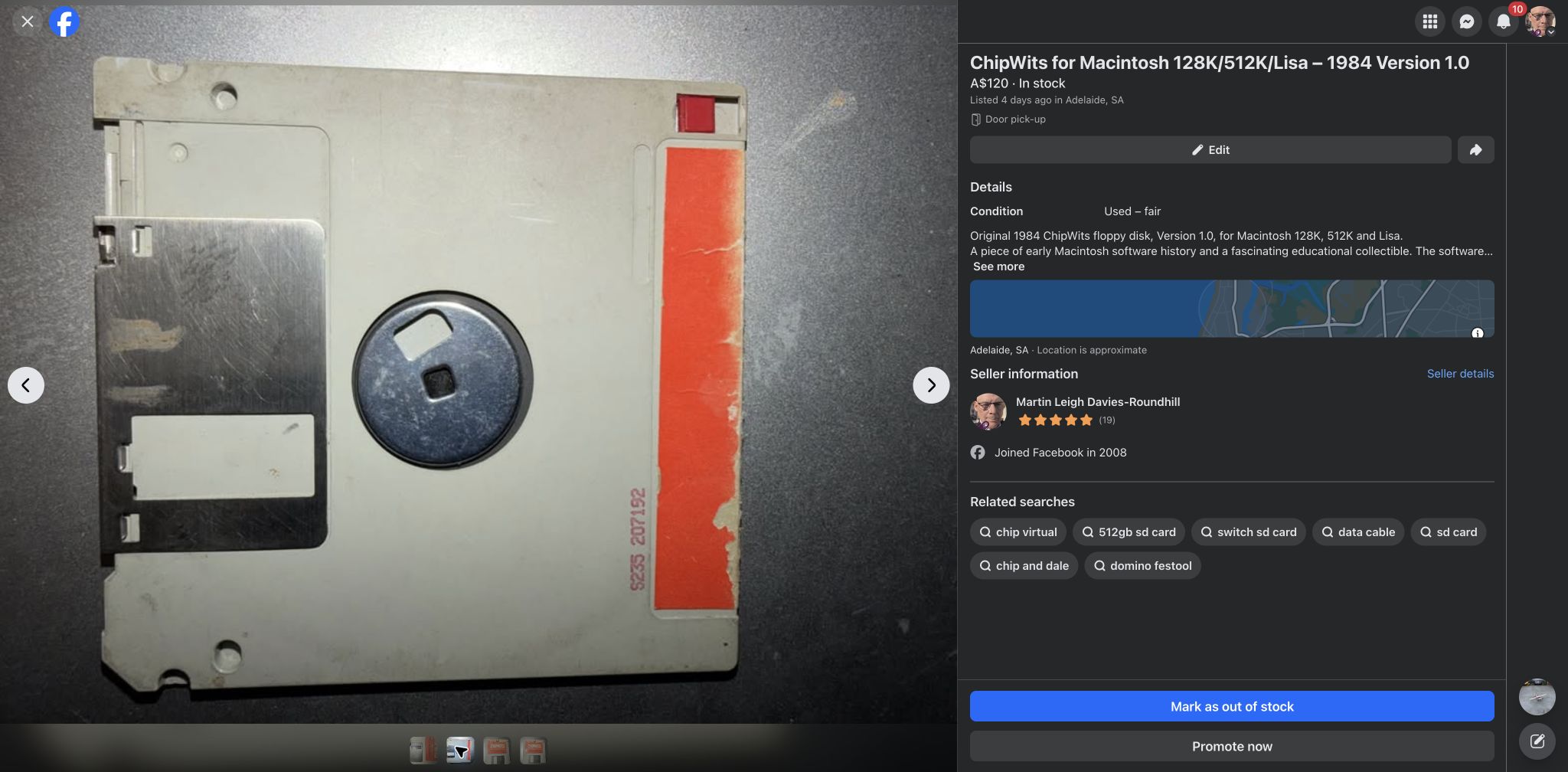
USD $40–$120
Estimated realistic range for this disk sold to a collector, based on comparable 1984 Mac software sales

The reference point: a complete 1984 Macintosh MacWrite/MacPaint boxed set — original box, disks, manual, cassette — listed on eBay at USD $299.99. That is a complete retail package from the same year, from Apple's own bundled software, with all original materials. A bare software disk from a third-party title, without the box, manual, or sleeve, commands less.

Comparable early Mac third-party software disks in identifiable condition typically sell in the $30–$80 range. ChipWits earns a premium for three reasons: it is a named, award-winning title with documented historical significance; it appears in the Macintosh's launch year; and it has an active, engaged community following the 2024 open-source release and Steam reboot. That community creates real demand.

With documented provenance — a first owner who bought it at original release and held it for forty years — the realistic ceiling rises. Provenance is what collectors pay above the base rate, because it converts a bare object into a documented artifact. The upper bracket of $120 assumes a buyer who cares about that story. Some will.

What would increase the value

Original box, sleeve, and manual (most copies were sold with these — the disk alone is the floor, not the ceiling). A letter or dated receipt confirming purchase at the time. A formal provenance statement from the owner. Sale through a venue that reaches serious vintage computing collectors rather than general eBay.

Honest caveat

No completed sale of a ChipWits Version 1.0 disk was located during research. The range above is constructed from the MacWrite/MacPaint boxed set listing, comparable early Mac software transactions, and an assessment of ChipWits' specific cultural weight. It is an informed estimate, not a confirmed valuation. An expert appraisal from a vintage computing specialist would give a more precise number.

The sentimental value and the market value are different things and should not be confused. The market value is what a collector would pay for the object. The personal value is the record of a specific moment — Bruce McLeod's house, a 128K Macintosh, a robot learning to navigate a maze — that changed how one person understood what computing could be. Those are not the same number.

Forty-two years in the world

The Macintosh was announced in January 1984. ChipWits shipped for Christmas of that same year. This disk is therefore from the first year of the Macintosh's existence — before most people in Australia had seen one, before the category of personal computing was established in the public mind, before anyone knew whether the machine would survive.

The wider personal computer field was still extremely young. The Apple II was only a few years old. The IBM PC had launched in 1981. Texas Instruments, Commodore, Atari — the field was crowded and still sorting itself. The Macintosh was a bet that the interface could be the product. ChipWits was one of the first pieces of software that proved the bet was serious.

To have seen it then, and bought the disk, and kept it — through moves, through years, through every phase of computing that followed — is to have maintained a physical thread back to that moment. Most people who saw ChipWits in 1984 do not still have their copy. The disks wore out, got lost, were thrown away in the great clearances that punctuate every life. This one survived.

It survived because it meant something. Not necessarily consciously — not filed away under "historical artifact." Just kept. The way certain objects get kept, without an explicit reason, because some part of you recognises that they should not be discarded.

Martin Davies-Roundhill is 69 years old. He bought this disk in 1984. He is holding it now. Forty-two years of computing history — from the 128K Macintosh to the AI agent that is writing these words — separate those two facts.

The disk is worn. The label is creased. It is exactly what it looks like: an original artifact from the dawn of personal computing, held by the person who bought it, at the moment it was new.